Digital Economy
Digital Capital, Equity, Credit, and Intelligence: Strategy's Digital-Economy Thesis
A critical guide to Strategy's digital-economy labels, from Bitcoin and corporate equity to preferred credit and AI.
Published October 11, 2026 · 7 min read
Strategy uses four labels to describe parts of its digital-economy thesis: Digital Capital for Bitcoin, Digital Equity for MSTR, Digital Credit for STRC, and Digital Intelligence for artificial intelligence, illustrated by NVIDIA. Taken together, the labels suggest a way to think about scarce digital assets, corporate financing, income securities, and machine-driven production.
This article organizes those labels into a framework for analysis. It is not a formal financial taxonomy, and the categories are not interchangeable assets or layers of legal ownership. Strategy’s charts are issuer-produced snapshots, not independent performance research. Their comparisons illustrate the company’s argument; they do not establish that any asset will repeat past results or outperform in the future.
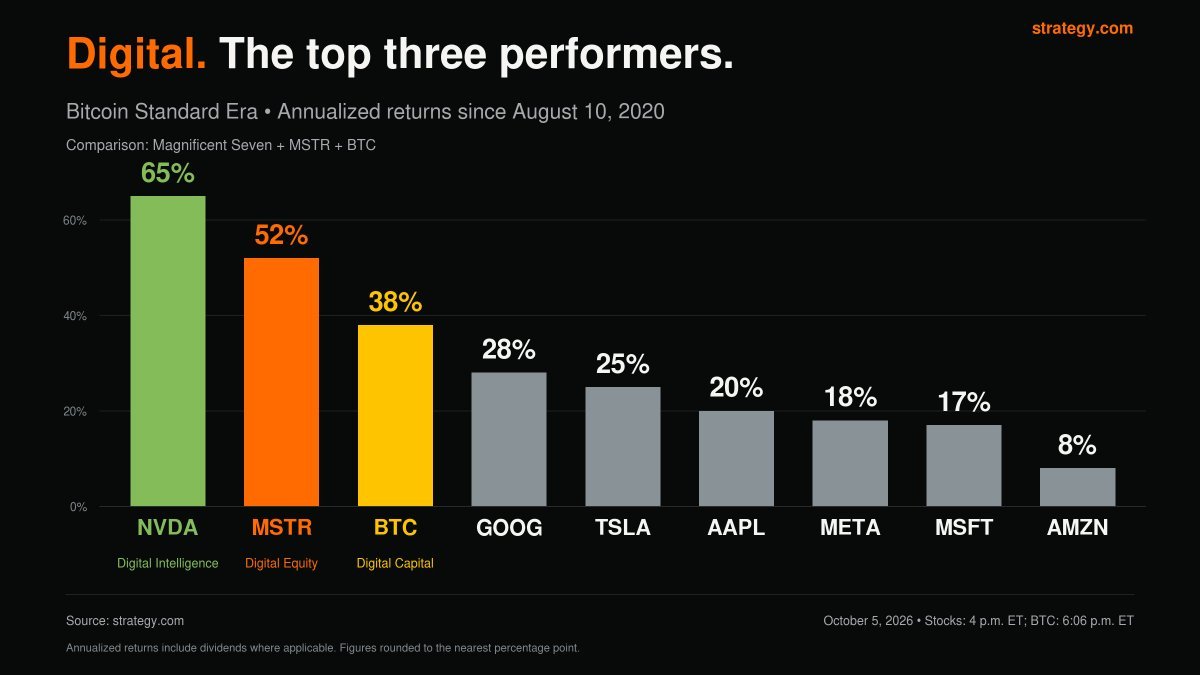 Figure 1: Strategy’s historical annualized-return comparison since August 10, 2020. It reports 65% for NVIDIA, 52% for MSTR, and 38% for Bitcoin. Source: Strategy.com, October 5, 2026. Returns include dividends where applicable; past performance is not a forecast.
Digital capital: Bitcoin as a scarce asset
Bitcoin is the framework’s monetary reference point. Its issuance follows rules enforced by the network, and its supply schedule is publicly auditable. That makes it different from corporate shares, which can be issued by a company, and from fiat currencies, whose supply is managed by central banks.
Scarcity alone does not make an asset a reliable store of value. Bitcoin’s market price has been highly volatile, it does not produce contractual cash flows, and its value depends on continued demand and the operation of the network. Self-custody can reduce reliance on a custodian, but it does not make a holder immune to theft, coercion, loss of keys, or legal seizure.
Strategy’s October 5, 2026 comparison labels BTC as Digital Capital and reports a 38% annualized return since August 10, 2020. That is a historical result for a selected start date and period, not a forecast or an expected return.
Digital equity: MSTR as corporate exposure
MSTR is common stock in Strategy, not a tokenized share of Bitcoin. Shareholders own an equity claim on the company, whose assets, liabilities, operating business, financing decisions, and share count all affect the stock. Strategy’s October 5 chart labels MSTR Digital Equity and reports a 52% annualized return over the same period used in its comparison.
A treasury company can raise capital and use some of it to acquire Bitcoin. Whether that increases Bitcoin exposure per share depends on the issue price, fees, existing liabilities, and how many new shares are created. Issuance is not automatically accretive, and shareholders remain exposed to both Bitcoin-price movements and changes in the market premium or discount applied to the stock.
Digital credit: STRC is preferred stock, not a deposit
Strategy labels STRC Digital Credit. Legally, STRC is a perpetual preferred stock issued by Strategy, not a token, bank deposit, or bond with a scheduled maturity. Strategy adjusts its stated dividend rate with the aim of keeping the market price near its $100 par value. The rate, market price, liquidity, and payment of future dividends are not guaranteed; investors depend on the issuer’s ability and decision to make payments under the security’s terms.
In a Strategy graphic dated October 7, 2026, STRC’s stated effective yield is 12.07%, compared with yields shown for selected preferred-stock, bond, and Treasury ETFs. The figures are a snapshot, and a quoted yield is not the same as a guaranteed total return. These instruments differ in credit risk, duration, price behavior, distribution policy, and legal structure, so the chart is not a like-for-like risk comparison.
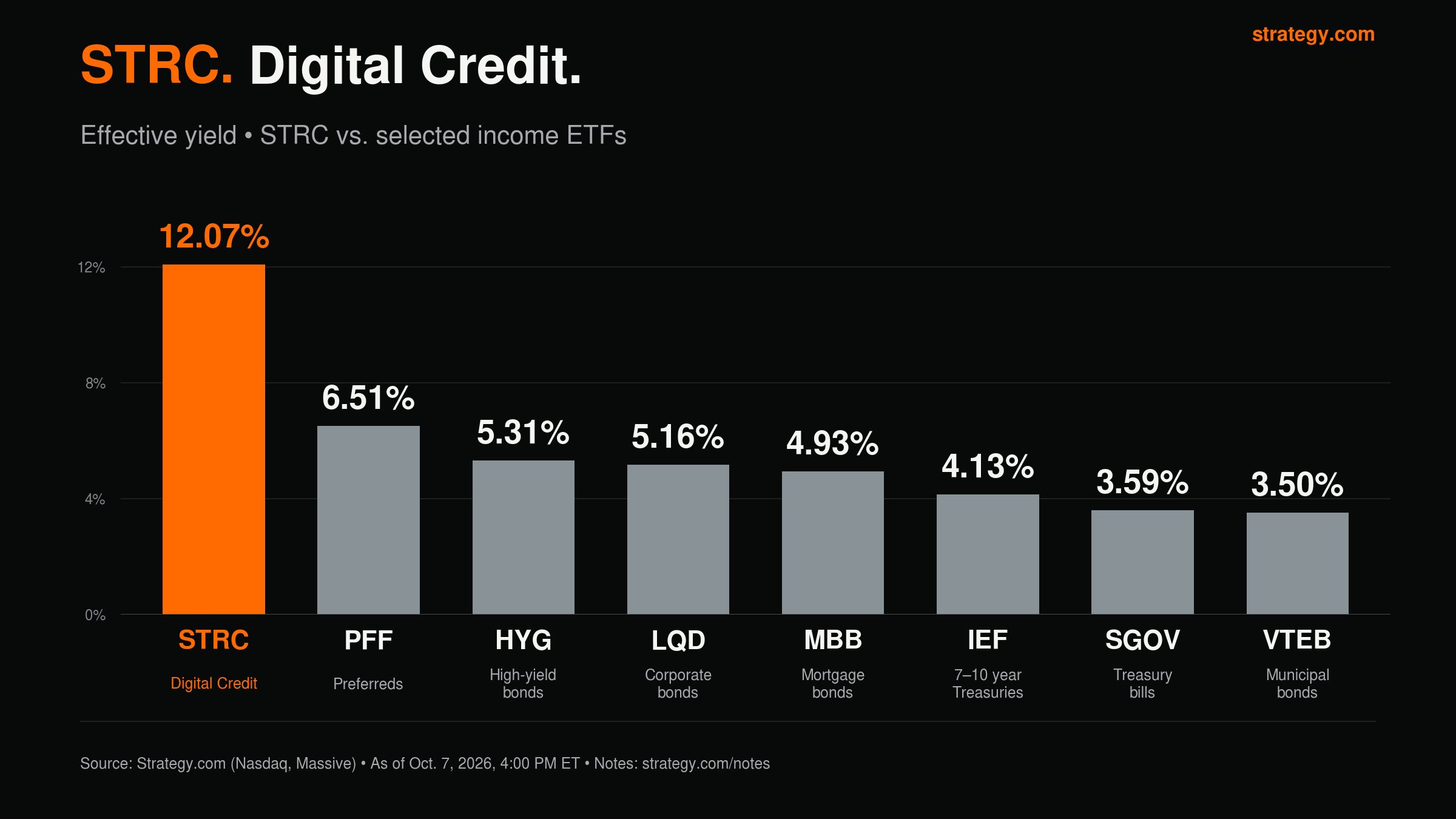 Figure 2: Strategy’s reported effective yield for STRC and selected income ETFs as of October 7, 2026, at 4 p.m. ET. Source: Strategy.com. Yield figures are variable and do not imply comparable risk or guaranteed returns.
The October 2 graphic reports 30-day historical volatility of 9% for STRC, 39% for Bitcoin, and 94% for MSTR. Historical volatility describes a past window; it does not establish future stability or prevent a price decline.
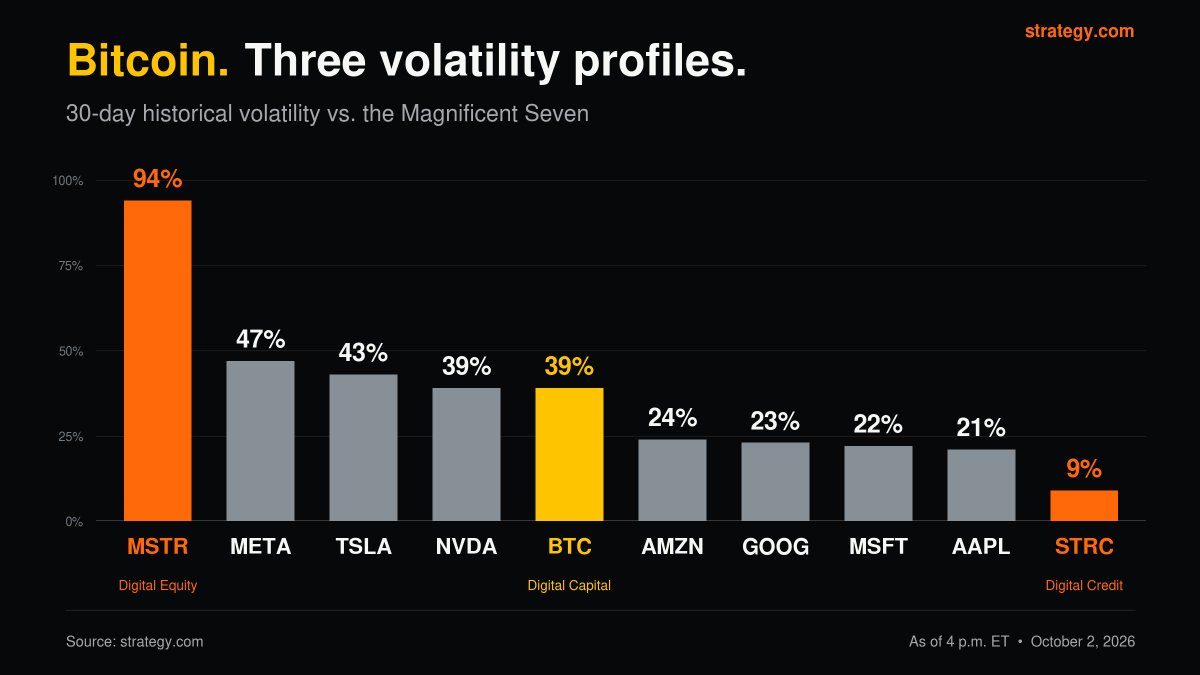 Figure 3: Strategy’s 30-day historical volatility comparison as of October 2, 2026, at 4 p.m. ET. It reports 94% for MSTR, 39% for Bitcoin, and 9% for STRC. Source: Strategy.com. Historical volatility is not a measure of credit quality or a guarantee of future price stability.
STRC holders do not have a direct claim on Strategy’s Bitcoin as collateral. For security terms, dividend risks, and a comparison with other treasury-company securities, see our Bitcoin treasury companies guide.
Digital intelligence: AI as a productive force
Strategy’s October 5 chart uses NVIDIA as its example of Digital Intelligence, reporting 65% annualized returns over the same historical period. The label points to the economic importance of AI hardware and software, but NVIDIA shares represent an ownership interest in a company; they are not the intelligence itself.
AI systems can automate some tasks and increase output in particular domains. They do not make every good or service infinitely reproducible: energy, chips, materials, physical infrastructure, time, and human preferences remain constraints. How much AI changes productivity, employment, or asset values is uncertain. The idea that autonomous agents will need faster, programmable payment rails is a plausible design thesis, not proof that a particular payment network or asset will prevail.
Tokenized shares are a separate question
A Strategy graphic dated October 8, 2026 estimates $491 million in circulating tokenized value associated with Strategy securities, split between $246 million attributed to MSTR and $245 million to STRC. The graphic credits DeFiLlama, with CoinGecko and RWA.xyz used where values were not listed, and says its total excludes locked shares, unsold issuer tokens, wrappers, and ETFs.
That estimate concerns tokenized representations tracked across third-party platforms. It should not be read as the total market value of Strategy’s listed securities or proof that every token holder has the same shareholder or preferred-stock rights as a registered security holder. Rights and recourse depend on the particular token, issuer, custodian, and legal documents.
What the framework does and does not say
The four labels offer a useful map of Strategy’s argument: Bitcoin is positioned as scarce digital capital; MSTR as equity exposure and a corporate financing vehicle; STRC as a yield-oriented preferred security; and AI as a source of potential productivity growth. The map also groups unlike things. Bitcoin is a network asset, MSTR and NVIDIA are corporate equities, STRC is a perpetual preferred security, and AI is a technology category.
The graphics support a narrower conclusion: Strategy is presenting these assets and technologies as related parts of its digital-economy thesis. They do not prove that equity issuance will always increase Bitcoin per share, that STRC will preserve principal or deliver a stated yield, or that Bitcoin and AI equities will keep their historical returns. A more complete account of MSTR, STRC, and their balance-sheet risks is available in our treasury-company comparison.
This article is educational research, not investment advice. The securities and assets discussed can lose value, and historical performance, yield, and volatility do not guarantee future results. Verify current security terms and issuer filings before making financial decisions.
Sources and limits
- Strategy’s four labels and dated comparisons: Strategy materials shared by Michael Saylor (@saylor) on X. The supplied graphics are dated October 2, 5, 7, and 8, 2026; Strategy’s notes are at strategy.com/notes, and Saylor’s account is @saylor. The images are issuer material. The return comparison states that its period begins August 10, 2020, includes dividends where applicable, and rounds figures to whole percentages.
- STRC terms: Strategy’s STRC information page and the security’s SEC filings. STRC is perpetual preferred stock; quoted rates and market prices can change, and the instrument is not a bank deposit or a direct claim on Bitcoin.
- Tokenized-equity estimate: The October 8 graphic credits DeFiLlama, with CoinGecko and RWA.xyz as supplemental data sources. Definitions and platform coverage can change; the estimate is not a legal classification of token holders’ rights.
- Figures are reproduced as dated snapshots from Strategy’s graphics, not independently recalculated or audited here. The exact methodology for the reported yield and historical volatility is not fully described in the graphics, so those comparisons should be interpreted cautiously.
- All product terms, market data, and platform coverage can change. Consult each issuer’s current disclosures and applicable filings.
Research
More research
Bitcoin Gift Guide
10 Physical Gifts You Can Pay for With Bitcoin (2026 Guide)
Ten physical gifts you can buy with Bitcoin, from Peony Lane wine and El Salvador coffee to books, a mug, and useful gear.
Bitcoin Art & Collectibles
Bitcoin Art and Collectibles: Where to Find Physical Pieces
A guide to Bitcoin-inspired prints, fine art, maker goods, and physical collectibles, with places to browse and tips for evaluating listings.