Bitcoin and gold
Bitcoin or Gold? A Practical Comparison in a Debasement Regime
A neutral comparison of Bitcoin and gold through monetary properties, fiscal dominance, and the cost of an illustrative grocery basket.
Published September 4, 2026 · Updated September 4, 2026 · 7 min read
Bitcoin and gold are often placed in the same sentence: both are scarce assets that can sit outside the direct liabilities of a commercial bank. That similarity is useful, but it can also hide important differences. Gold is a physical monetary asset with thousands of years of history. Bitcoin is a digital bearer asset with a transparent issuance schedule, global transferability, and a much shorter record.
The better question is not which asset wins in every environment. It is which properties matter for a particular monetary problem, and what the historical data can actually show.
The grocery basket as a common measuring stick
The Grocery Purchasing Power in Bitcoin Calculator offers a practical way to compare the two assets. It expresses the same illustrative grocery basket in local currency, Bitcoin, and gold over a series beginning in 2015.
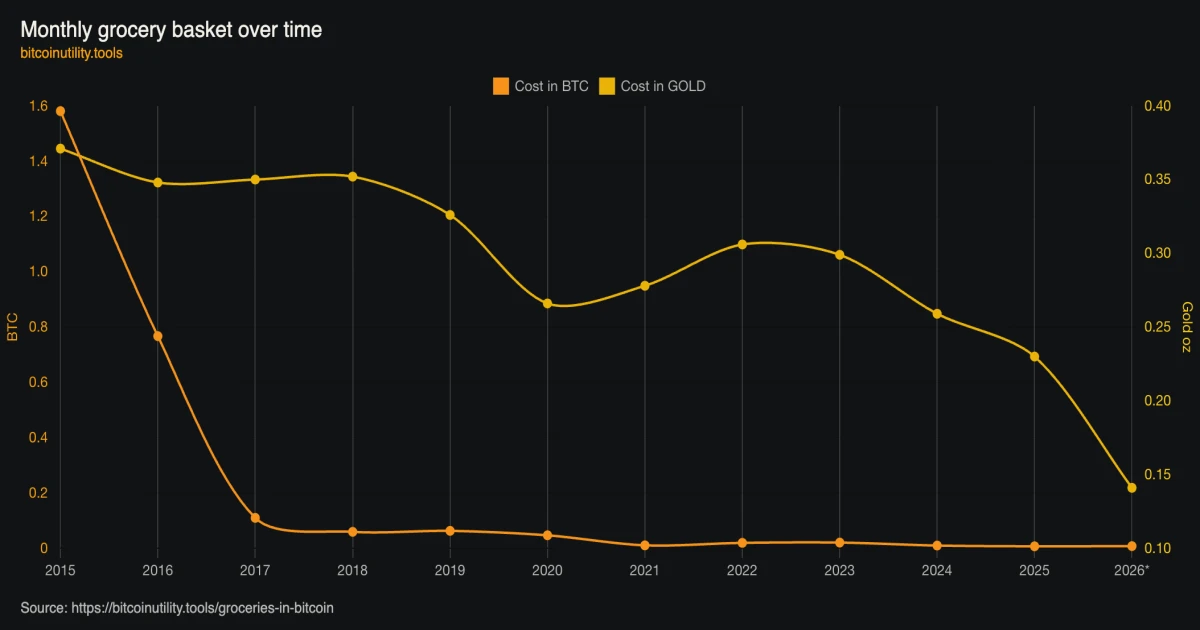 Figure 1: An illustrative grocery basket expressed in Bitcoin and gold from 2015 through 2025, with a starred 2026 estimate. Source: Bitcoin Utility Tools Grocery Purchasing Power Calculator.
In the underlying example, the basket moves from about 1.58 BTC in 2015 to about 0.007176 BTC in 2025. The chart also shows a starred 2026 estimate. Its gold-denominated cost changes over the same period, but the two lines do not measure the same thing as a consumer-price index. They show how the price of one modeled basket changes when the basket is divided by the market price of each asset.
That distinction matters. A falling BTC-denominated cost mainly reflects Bitcoin rising faster than the modeled basket during that period. It does not prove that every household experienced lower costs, that Bitcoin will continue to outperform, or that the asset is a reliable short-term inflation hedge. The gold view has the same limitation.
Gold and Bitcoin solve different custody problems
Gold’s strongest monetary property is its independence from a digital network. A coin or bar can be held without a software protocol, internet connection, or Bitcoin exchange. That makes physical gold relevant for people who value an offline reserve and a long-established market. The tradeoffs are storage, insurance, transport, assay risk, bid-ask spreads, and the possibility that convenient ownership introduces a custodian or financial intermediary.
Bitcoin replaces physical storage with key management. A holder can transfer a large value across borders using a network and divide it into very small units. Self-custody can reduce dependence on an intermediary, but it creates operational responsibilities: lost keys cannot normally be recovered, transactions are irreversible, and access depends on sound procedures. Exchange custody, lending, derivatives, and tokenized claims can reintroduce counterparty risk.
Gold usually has lower day-to-day volatility and a longer record across monetary regimes. Bitcoin has a more observable monetary policy and easier digital transfer, but its market history includes severe drawdowns. Liquidity, regulation, network adoption, market structure, and global interest rates can all affect Bitcoin’s price independently of a long-term debasement thesis.
Fiscal dominance and debasement
Fiscal policy concerns government spending, taxation, and borrowing. Monetary policy concerns a central bank’s management of interest rates, liquidity, and the money supply. Fiscal dominance occurs when the government’s fiscal needs begin to limit how freely the central bank can use monetary policy to control inflation.
Fiscal dominance describes a situation in which a government’s fiscal position constrains monetary policy. Large deficits, rising interest costs, or political limits on taxation can make it harder for a central bank to keep policy focused only on price stability. The result need not be immediate consumer-price inflation. Currency debasement, asset-price inflation, financial repression, and a gradual loss of purchasing power are related possibilities, but they are not interchangeable measurements.
This framework is central to the work of several macro commentators, although their views should not be treated as a single consensus. In her 2020 article 3 Reasons I’m Investing in Bitcoin, Lyn Alden discusses the interaction between fiscal and monetary policy, money creation, and scarce assets such as Bitcoin and gold. Luke Gromen’s FFTT research emphasizes long-cycle relationships among government debt, geopolitics, and the global monetary system. Ray Dalio develops a historical account of debt cycles, reserve currencies, and monetary debasement in Principles for Dealing with the Changing World Order.
These are analytical frameworks, not forecasts that determine the next price move. The relevant question for Bitcoin and gold is how their properties behave if fiscal constraints become more important.
What debasement could mean for gold
Gold has no issuing government and cannot be created at will by a central bank. Its supply grows through mining, and above-ground holdings form a large existing market. In a debasement scenario, investors may seek an asset that has no direct claim on the solvency of the currency issuer. Gold’s long history and established physical market support that use case.
Gold is not a perfect or continuous inflation hedge. Its price can fall in real terms over long intervals, and it can be pressured by real interest rates, a stronger reserve currency, forced selling, or changes in investor demand. Physical ownership also carries costs that a simple spot-price chart does not show.
What debasement could mean for Bitcoin
Bitcoin’s monetary case rests on a different foundation. Its protocol limits issuance according to rules that are visible and difficult to change without broad network agreement. It can be held and transferred digitally, and a user can take direct custody without needing permission from a central issuer.
Those properties may be attractive when confidence in monetary institutions weakens. They do not remove market risk. Bitcoin remains a young asset whose price has been highly sensitive to global liquidity and risk appetite. Regulation, wallet security, internet access, exchange failures, and changes in adoption can matter as much as the debasement narrative.
How to read the comparison
The grocery chart is a purchasing-power illustration, not a recommendation and not a complete investment backtest. It uses an illustrative basket, annual asset-price inputs, and modeled food-price trends. It excludes taxes, transaction costs, storage, insurance, custody, financing, and changes in income. The period also gives Bitcoin a much shorter history than gold and is sensitive to the chosen start and end dates.
For a live view of the underlying Bitcoin series and its moving averages, see the Bitcoin Price Tracker and Mapping Bitcoin Cycles with Moving Averages. The calculator lets you switch between Bitcoin and gold so that the comparison can be tested against the same basket rather than two unrelated spending examples.
A use-case decision, not a universal winner
Gold may fit a person who prioritizes a physical reserve, established market history, and lower volatility. Bitcoin may fit a person who prioritizes digital portability, divisibility, a transparent issuance schedule, and the possibility of self-custody. Some people may value exposure to both because their risks are different.
Neither asset is automatically protected from every form of inflation, policy error, market stress, or loss of purchasing power. The useful conclusion is narrower: fiscal dominance can make monetary properties more important, but the right comparison depends on custody, time horizon, liquidity needs, volatility tolerance, and the specific risk a holder is trying to manage.
Sources and limits
- Grocery basket methodology and asset inputs: Grocery Prices in Bitcoin and the Grocery Purchasing Power in Bitcoin Calculator. The site’s basket is illustrative and should not be read as a household budget.
- Macro framework: Lyn Alden’s 2020 article 3 Reasons I’m Investing in Bitcoin, Luke Gromen’s FFTT research, and Ray Dalio’s Principles for Dealing with the Changing World Order. These sources present the authors’ views; they are not independent proof of future asset performance.
- Bitcoin market data: the underlying calculator documentation identifies CoinGecko as its Bitcoin price source. Gold pricing is identified there as Gold-API. Prices, dates, exchange rates, and provider methodologies can change.
- Fiscal dominance, debasement, and CPI inflation are distinct concepts. A market price can rise without consumer prices rising at the same rate, and a grocery basket can become cheaper in an asset unit without becoming cheaper for a household in local currency.
- This article is educational research, not personal financial advice.
Research
More research
Digital Economy
Digital Capital, Equity, Credit, and Intelligence: Strategy's Digital-Economy Thesis
A critical guide to Strategy's digital-economy labels, from Bitcoin and corporate equity to preferred credit and AI.
Bitcoin Gift Guide
10 Physical Gifts You Can Pay for With Bitcoin (2026 Guide)
Ten physical gifts you can buy with Bitcoin, from Peony Lane wine and El Salvador coffee to books, a mug, and useful gear.