Market Indicators
Mapping Bitcoin Cycles with Moving Averages
How professional analysts use the 200-day and 200-week moving averages to cut through daily noise and identify macro market trends.
Published September 3, 2026 · Updated September 3, 2026 · 3 min read
Bitcoin’s daily price action is notoriously chaotic. Driven by leverage, news cycles, and algorithmic trading, short-term volatility can easily obscure the broader macroeconomic trend. To navigate this, professional market watchers and institutional traders rely on tools that strip away the daily noise to reveal the underlying structure of a cycle.
Two of the most widely respected metrics for this are the 200-day and 200-week moving averages (MAs).
By calculating the average closing price over these extended timeframes, these indicators plot a smoothed trajectory of Bitcoin’s historical price. They act as reference points for market sentiment, helping participants contextualize whether the market is expanding, contracting, or capitulating.
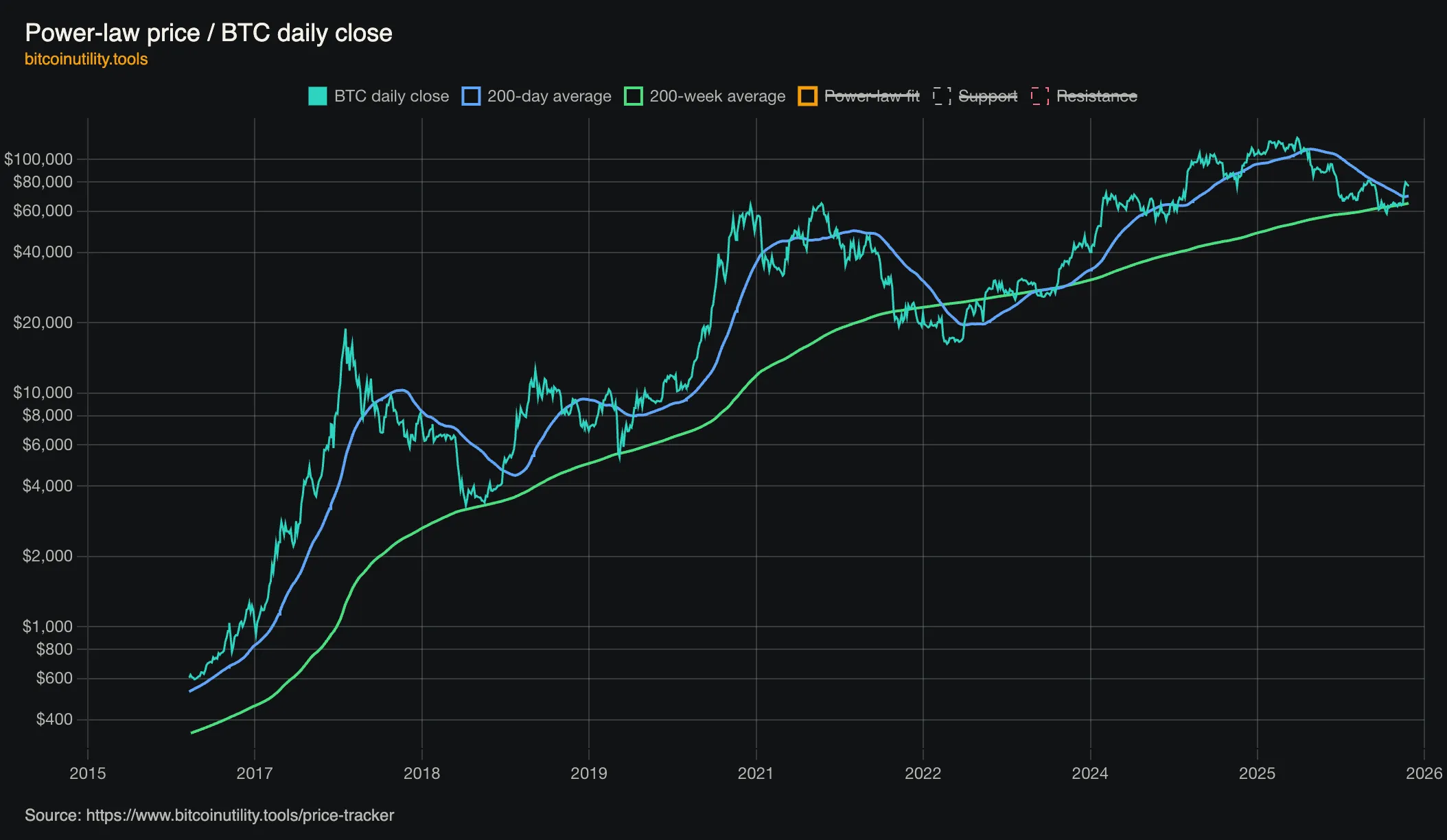 Figure 1: Power-law price, Bitcoin daily close, and moving averages. Source: Bitcoin Utility Tools price tracker.
The 200-Day Moving Average: The Trend Boundary
In traditional finance and digital assets alike, the 200-day MA is widely considered the psychological boundary between a macro bull and bear regime. It provides a medium-term pulse on the market.
- Bull Market Context: When Bitcoin’s spot price sustains itself above the 200-day MA, it generally indicates that buyers are in control and the path of least resistance is upward.
- Bear Market Context: Conversely, a decisive and sustained breakdown below this line often marks the transition into a distribution phase or a prolonged bear market.
Professional analysts don’t use the 200-day MA to catch exact local tops or bottoms. Instead, they use it to define the prevailing weather: it tells you whether you are sailing with the macroeconomic wind or fighting against it.
The 200-Week Moving Average: The Generational Floor
If the 200-day MA dictates the medium-term environment, the 200-week MA represents Bitcoin’s absolute macroeconomic floor. Cycles in Bitcoin take years to play out, and the 200-week horizon captures the deepest underlying accumulation trends.
Historically, this indicator has been the ultimate capitulation target during the darkest depths of bear markets. When speculative excess is violently flushed from the system, Bitcoin has often retraced down to—and occasionally wicked just below—its 200-week MA before establishing a cycle bottom.
Touching this line indicates that the market has been entirely drained of leverage and short-term tourists, leaving only long-term, high-conviction holders.
Descriptive, Not Predictive
A critical mistake retail traders make is treating these moving averages as mechanical buy or sell triggers.
Like the power-law fit, moving averages are strictly descriptive indicators, not predictive trading signals. They are mathematically lagging; they summarize where the asset has been over the last 200 periods, not where it is guaranteed to go tomorrow.
Price can, and often does, deviate below these averages during extreme liquidity events—such as the March 2020 crash or the late 2022 capitulations—before eventually mean-reverting. If you treat a cross of the moving average as an automatic signal to execute a trade, you risk getting chopped up in fake-outs and volatility spikes.
Finding the Signal
Understanding Bitcoin requires shifting your perspective from daily price checking to macro cycle analysis.
The 200-day and 200-week moving averages exist to give you that wider lens. By anchoring your analysis to these historical baselines, you can transition from reacting to market emotion to objectively mapping out where Bitcoin sits in its multi-year cycle.
Research
More research
Digital Economy
Digital Capital, Equity, Credit, and Intelligence: Strategy's Digital-Economy Thesis
A critical guide to Strategy's digital-economy labels, from Bitcoin and corporate equity to preferred credit and AI.
Bitcoin Gift Guide
10 Physical Gifts You Can Pay for With Bitcoin (2026 Guide)
Ten physical gifts you can buy with Bitcoin, from Peony Lane wine and El Salvador coffee to books, a mug, and useful gear.