Bitcoin utility and monetary regimes
Bitcoin Utility: A Beginner's Guide
What Bitcoin is useful for, how fiscal dominance could affect purchasing power, and how Bitcoin compares with gold, cash, bonds, equities, and real estate.
Published November 2, 2026 · 12 min read
Bitcoin has two kinds of utility that are easy to mix together. The Bitcoin network lets people hold and transfer digital value without relying on one central operator. Bitcoin (BTC) is also a market-priced asset whose supporters see its constrained issuance as a potential long-term store of purchasing power.
This guide explains both ideas, then compares Bitcoin with gold, cash, government bonds, equities, and real estate through the lens of fiscal dominance. The scarce-hard-asset case is worth understanding, but scarcity alone does not guarantee demand, a stable price, or protection from inflation.
What does fiscal dominance mean?
Fiscal policy is how a government taxes, spends, and borrows. Monetary policy is how a central bank manages interest rates and monetary conditions. Fiscal dominance describes a situation where government financing needs constrain how freely monetary policy can focus on its goals, such as price stability.
For example, if higher interest rates sharply raise the cost of servicing public debt or threaten financial stability, policymakers may face pressure to keep borrowing costs lower or support markets. The details depend on a country’s institutions, debt structure, currency, and political choices. High public debt by itself does not prove that fiscal dominance is happening, and governments do not automatically fund every deficit by creating money.
Fiscal dominance is a way to think about tensions between fiscal and monetary policy, not a prediction that a currency crisis or rapid inflation must follow. The Bank for International Settlements has modeled how bond issuance, monetary policy, and liquidity can interact; its results also show why the outcome depends on the conditions in a particular model. Lyn Alden’s analysis of fiscal dominance presents one current interpretation, not a settled consensus about every country’s situation.
It also helps to separate three ideas:
- Consumer-price inflation is a broad rise in the prices of goods and services. A single price increase is not, on its own, inflation; the Federal Reserve explains how price indexes measure it.
- Currency debasement is a decline in money’s purchasing power or credibility. It can happen gradually and is not measured by one price index alone.
- Asset-price inflation is a rise in the prices of assets such as shares, property, gold, or Bitcoin. It can happen while consumer-price inflation is low, high, or falling.
These processes can influence one another, but they are not interchangeable. An asset rising in price does not automatically mean household expenses have fallen or that it hedged the cost of living.
What is Bitcoin useful for?
Bitcoin is an open payment and settlement network as well as the asset transferred on it. It can be useful to someone who wants to hold digital value directly, move it without asking a particular bank to approve each transfer, or receive it across borders where the sender and recipient have suitable internet access. Those properties can matter even when the owner does not plan to buy everyday goods with BTC.
Bitcoin is divisible: one bitcoin contains 100 million smaller units called satoshis. A wallet is software or a device that manages the private keys used to authorize spending; it does not hold coins like a physical purse. The coins are recorded on a shared public ledger. A wallet can be self-custodied, giving the user control of the keys, or held by an exchange or other custodian, which introduces reliance on that provider.
The network’s base layer records transactions in blocks. Confirmation times and fees vary with network demand; a block is found roughly every ten minutes on average, not on a guaranteed schedule. Transactions are generally difficult to reverse after confirmation, and the public ledger can reveal activity. Bitcoin is pseudonymous, not automatically private or anonymous.
The Lightning Network is a payment layer built on Bitcoin that can support faster, smaller payments through payment channels. It brings its own operational details, such as channel liquidity and the choice between self-managed and custodial services. It does not remove Bitcoin’s price volatility, make every merchant accept BTC, or make every payment risk-free.
These network features are distinct from an investment thesis. A payment network can be useful without its asset price rising; a scarce asset can fall in price if demand weakens. Bitcoin’s long-term monetary case depends on both its rules and continued demand for the asset.
How Bitcoin compares with other assets
The table compares broad asset roles, not expected returns. Actual outcomes depend on the country, the specific asset, the purchase price, the holding period, and the way it is owned.
| Asset | What it can do | Why it may matter in a fiscal-dominance thesis | Main risks and limits |
|---|---|---|---|
| Bitcoin | Digital asset and transfer network; can be self-custodied and divided into small units. | Issuance follows rules enforced by the network. Under current rules, new issuance declines toward a limit of 21 million BTC. Its portability and scarcity may appeal to someone seeking an asset outside a government issuer’s direct control. | Bitcoin’s market price can be volatile, and it does not pay interest or dividends. Self-custody means managing private keys; custodial options involve relying on a provider. Fees, regulation, and access to software and connectivity can also affect how it is used. |
| Gold | Physical monetary metal with a long history of use and a deep global market. | Physical gold can be held outside a digital payment system and is not a liability of a bank or government when held directly. | New supply still comes from mining. Storage, insurance, transport, authenticity, and selling costs matter; gold can underperform or lose value over long periods. |
| Cash and bank deposits | Liquid funds for bills, emergencies, and near-term spending. | Cash is useful for obligations that must be paid in the local currency; deposits may earn interest and are convenient for payments. | Their purchasing power can erode if prices rise faster than the return. Physical cash, bank deposits, and money-market funds are different claims with different protections and risks. |
| Government bonds | Loans to a government, usually with scheduled interest and repayment terms. | They can provide income and match future spending in the same currency. Inflation-linked bonds, such as U.S. Treasury TIPS, adjust principal using a consumer-price index. | Nominal bonds can lose purchasing power to inflation; market prices generally fall when yields rise. Inflation-linked bonds still have market-price, tax, issuer, and index-mismatch risks, and are not available on the same terms in every country. |
| Equities | Ownership claims on companies, whose earnings may grow and whose prices or revenues can adjust over time. | Productive businesses may adapt prices, products, and investment as the economy changes. A diversified portfolio spreads company-specific risk. | Shares can fall sharply, businesses can fail, and valuations can change faster than earnings. Stocks are not a guaranteed inflation hedge at a chosen date or over every holding period. |
| Real estate | Land or buildings provide shelter, workspace, or rental income. | Useful property and rents may respond to local incomes, replacement costs, or prices over time. | Property is local and illiquid; taxes, maintenance, insurance, vacancies, financing, and leverage can dominate returns. A home is also a place to live, not just an investment. |
For U.S. readers, the Treasury’s description of TIPS explains how their principal is adjusted using CPI. FINRA’s bond overview describes bond income and interest-rate risks. The SEC’s Investor.gov guide to stocks and REITs covers listed securities; a REIT share is not the same thing as owning a building directly.
Why call Bitcoin a scarce hard asset?
“Hard asset” usually means an asset that is difficult to create or expand in supply. Gold is physically scarce and costly to mine. Bitcoin is digital, but its issuance schedule is set by the network’s rules: new BTC issuance falls over time, and the total is designed to approach 21 million under the current consensus rules. No individual developer, miner, or government can change those rules unilaterally; users and node operators choose which rule set to accept.
That makes Bitcoin’s scarcity unusually transparent and predictable compared with assets whose supply responds to prices, discoveries, or policy. It does not make the asset valuable by itself. A scarce item that nobody wants can still be worth little. Bitcoin’s monetary thesis therefore combines constrained supply with the expectation that people will continue to value its transfer network, divisibility, and ability to be held without a central issuer.
This is the trade: a holder accepts volatility, technology and custody responsibilities, and uncertainty about future demand in exchange for exposure to a digital asset with a rule-based supply schedule. Gold, property, companies, and bonds offer different forms of utility or income; Bitcoin does not replace those functions simply by being scarce.
Is Bitcoin a long-term inflation hedge?
It may serve as a long-term hedge for some holders if demand for Bitcoin persists or grows while the purchasing power of their local currency falls. But that is a thesis, not a guarantee. A fixed issuance schedule cannot promise a fixed market price, and Bitcoin’s history is short relative to gold, property, and diversified equity markets. Its price has also moved sharply in both directions.
“Inflation hedge” needs a time horizon and a measure. Do you mean matching a consumer-price index, preserving the cost of housing, maintaining purchasing power in one currency, or limiting exposure to a government issuer? An asset may help with one objective while failing another. Even an asset that outpaces inflation over decades can lose value during the year someone needs to sell it.
The same caution applies to historical charts. If a grocery basket costs fewer BTC after a period in which Bitcoin’s market price rose faster than food prices, that is a relative-price comparison for that period. It does not show that groceries became cheaper in local currency, prove that Bitcoin caused lower living costs, or forecast the next period. Our grocery-price research explains this distinction, and the fiat debasement calculator lets readers inspect several asset benchmarks without treating past returns as forecasts.
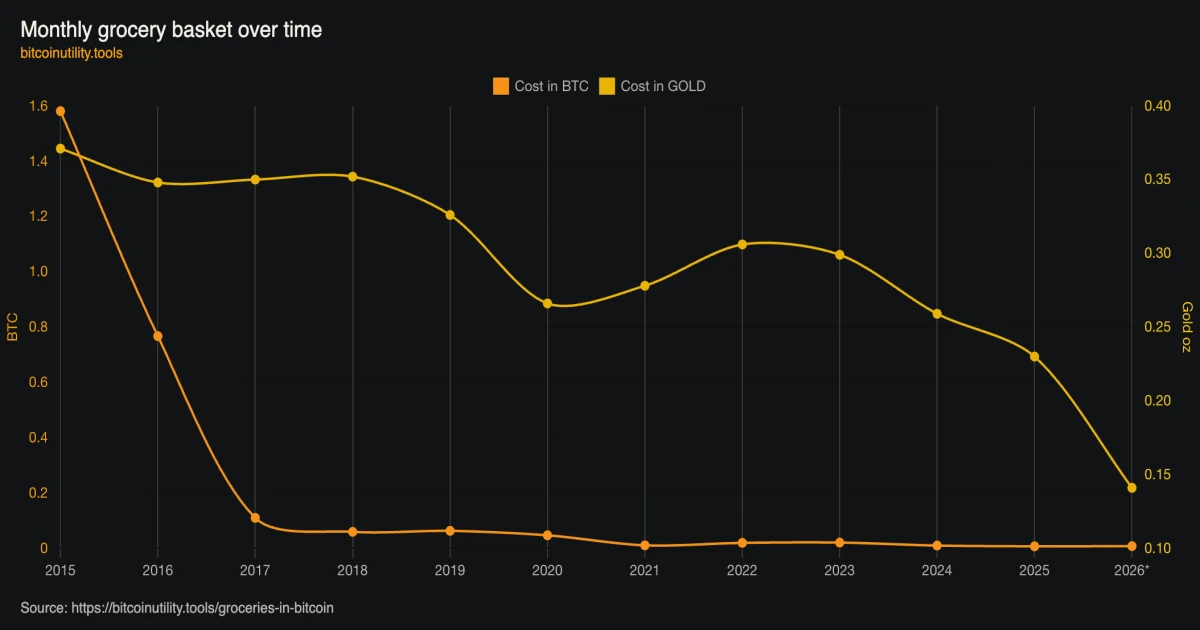 Figure 1: An illustrative grocery basket expressed in Bitcoin and gold from 2015 through 2025, with a marked 2026 estimate. This is a relative-price comparison, not a consumer-price index or a forecast. Source: Bitcoin Utility Tools Grocery Purchasing Power Calculator.
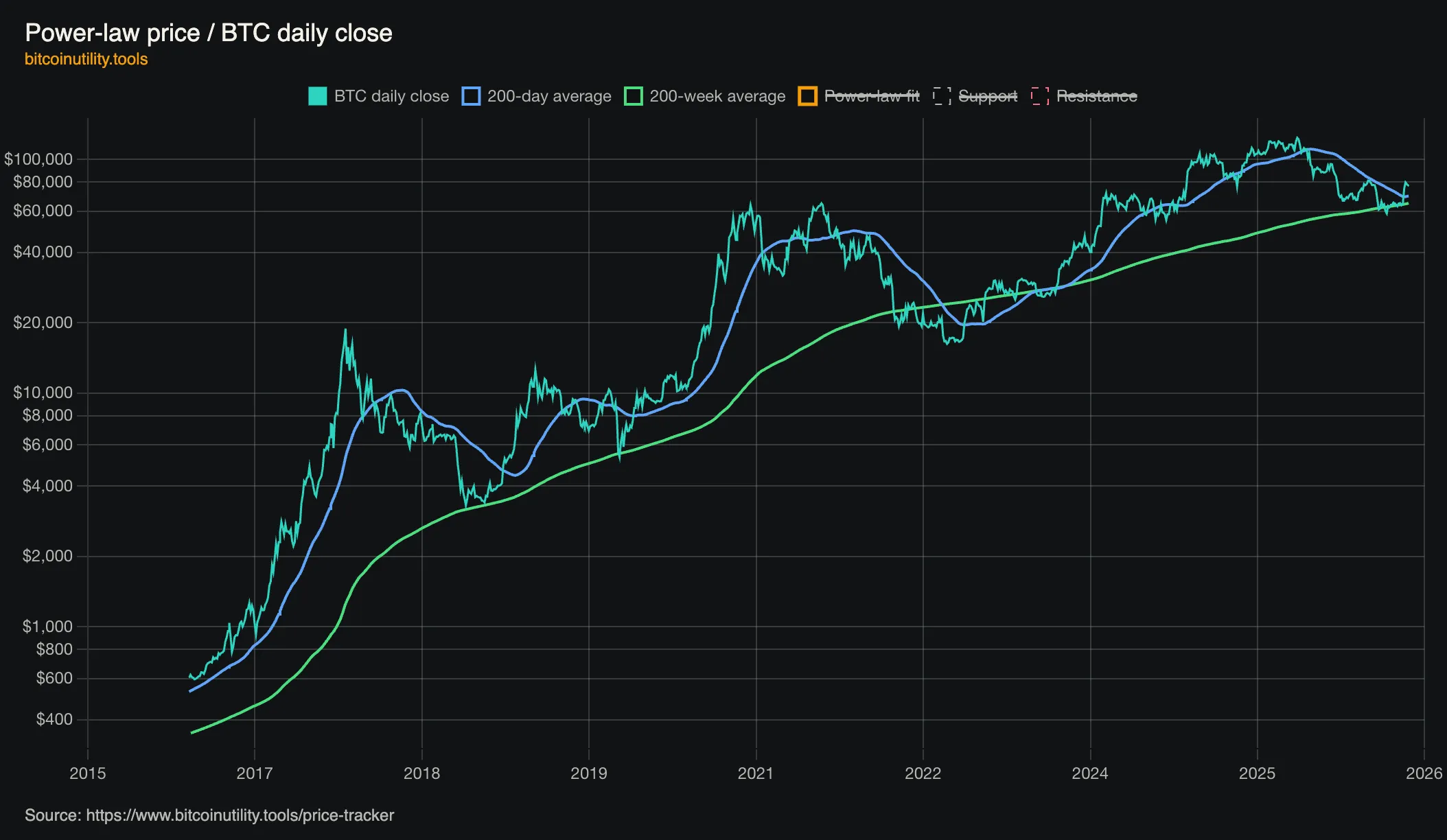 Figure 2: Bitcoin’s daily close alongside historical trend indicators. This chart describes past prices; it does not measure inflation-hedging performance or predict future returns. Source: Bitcoin Utility Tools Price Tracker.
When Bitcoin’s network utility matters
The asset comparison is only part of Bitcoin’s utility. Someone may value the network because it can settle a transfer between users without a bank acting as the central ledger operator. That can be relevant for international transfers, online payments, or self-custody, but it does not mean every transfer is cheaper or faster than a bank payment. Fees, confirmation times, exchange access, tax rules, and local law vary.
Self-custody also changes who carries the operational risk. If a custodian holds BTC, the user depends on that business’s security and solvency. If a user controls the private keys, they take responsibility for backups and access; a lost recovery phrase or mistaken transfer may be impossible to fix. Keeping some BTC on an exchange and some in a personal wallet are different custody choices, each with tradeoffs.
The public ledger is another tradeoff. Anyone can inspect confirmed transactions, though addresses do not automatically display a person’s legal name. Linking an address to a person can expose transaction history, so users should not assume Bitcoin provides cash-like privacy. The Bitcoin.org FAQ and the Bitcoin developer guide to transactions explain confirmation, fees, wallet keys, and privacy considerations in more detail.
A role for each kind of asset
Fiscal dominance makes it reasonable to ask how much a savings plan depends on one currency or one policy regime. It does not make a single asset right for every purpose. Near-term bills call for liquidity and nominal stability; longer-term goals may involve accepting market risk for growth, income, or purchasing-power exposure. Those are different jobs.
Bitcoin’s strongest differentiators are digital portability, self-custody, and a transparent issuance schedule. Gold offers physical independence from digital infrastructure; bonds can provide scheduled payments; businesses and property can produce goods, services, or rent; cash is ready for immediate spending. Each can lose purchasing power or market value through a different path.
For a deeper Bitcoin-versus-gold analysis, see Bitcoin or Gold?. For household savings decisions and money needed before an uncertain investment horizon, see The Cost of Living Keeps Rising - Can Bitcoin Help?. Neither comparison identifies a universal winner or a suitable personal allocation.
Sources and limits
- For an explanation of fiscal dominance, see Sam Callahan’s article commissioned and advised by Lyn Alden. It presents an interpretation of a possible macroeconomic regime, not a consensus forecast. The BIS working paper on monetary and fiscal policy interaction presents a model-based analysis whose results depend on its assumptions.
- The Federal Reserve’s inflation FAQ describes inflation as a broad rise in prices and explains how price indexes are used.
- Bitcoin.org’s FAQ covers issuance, volatility, the public ledger, wallets, fees, confirmations, and Lightning. The Bitcoin developer guide provides technical detail; the original Bitcoin paper describes the peer-to-peer electronic cash design.
- Asset mechanics: TreasuryDirect on TIPS, FINRA on bonds, and Investor.gov on stocks and REITs. These are U.S.-specific resources; securities and protections differ by jurisdiction.
- The comparison is qualitative, not a backtest or asset-allocation recommendation. Results depend on currency, entry price, period, taxes, fees, custody, leverage, and the measure of purchasing power. This article is educational and not personal financial advice.
Research
More research
Bitcoin ETFs
Beyond Spot Bitcoin ETFs: Dividend Drips and Protection Strategies
Franklin's stock-dividend Bitcoin ETFs and BlackRock's proposed options-protection ETF show how Bitcoin exposure is moving beyond spot funds.
Bitcoin Shopping in Australia
Where to Spend Bitcoin Online in Australia: Stores That Accept BTC
Five Australian online stores that accept Bitcoin, from locally made homewares to skateboards, fashion, Bitcoin gear and electronics.