Treasury Companies
Bitcoin Treasury Companies — Comparing MSTR, STRC and ASST
How Strategy's MSTR common stock and STRC preferred compare with Strive's ASST — and the NAV, dilution and dividend risks to weigh before investing.
تاريخ النشر 7 سبتمبر 2026 · آخر تحديث 7 سبتمبر 2026 · 14 دقيقة قراءة
A “Bitcoin treasury company” is a publicly traded corporation that holds bitcoin on its balance sheet as a reserve asset, then issues stock or debt to buy more. Investors can no longer just compare a handful of near-identical copycats. Strategy alone now offers five different securities, and challengers like Strive have added their own preferred-stock structures with different mechanics and risks.
This article compares the products that get the most investor attention today — Strategy’s MSTR common stock and STRC preferred, and Strive’s ASST common stock and SATA preferred — and explains the balance-sheet risks (NAV premium/discount, dilution, dividend suspension, leverage) that apply to all of them. This is not investment advice.
What is a Bitcoin treasury company?
A Bitcoin treasury company holds bitcoin as its primary reserve asset instead of cash, then uses public capital markets — common stock, convertible debt, or preferred stock — to raise money and buy more. Strategy (formerly MicroStrategy) pioneered the model in August 2020, and by November 17, 2025 it held over 650,000 BTC, worth roughly $59.7 billion, making it the largest corporate holder of the asset.[1]
As investment strategist Lyn Alden explained in a July 2025 analysis, the model appeals to two groups: fund managers whose mandates only permit stocks or bonds (not bitcoin or ETFs directly), and investors who specifically want the type of leverage a corporation can offer. Corporations can issue multi-year bonds rather than relying on margin loans, so a bitcoin price drop doesn’t force an immediate sale the way a margin call would.[2]
MSTR vs. STRC: what’s the difference?
MSTR is common stock. It gives direct equity exposure to Strategy’s bitcoin holdings, business operations, and share count — its price moves with both bitcoin and the market’s view of the company’s premium or discount to its bitcoin net asset value (mNAV, explained below).
STRC (“Stretch”) is a preferred stock, not equity in the same sense. It is Strategy’s Variable Rate Series A Perpetual preferred stock, with a $100 par value. Its dividend rate is adjusted monthly specifically to keep the share price trading near par and reduce volatility, paid out monthly in cash.[3] Strategy raised STRC’s dividend to 11.5% in March 2026.[4] Strategy has said it holds USD reserves providing roughly 21.8 months of coverage for these dividend payments.[5]
Strategy has issued four such preferred/credit instruments since 2025 — STRK, STRF, STRD, and STRC — raising a combined $4 billion. Executive Chairman Michael Saylor described them as high-yield perpetual securities designed to give investors bitcoin-linked exposure with less volatility than the common stock.[6]
| Product | Ticker | Type | How it pays | Redemption | Collateralized by BTC? |
|---|---|---|---|---|---|
| Strategy common stock | MSTR | Common equity | No fixed dividend; price tracks BTC + mNAV sentiment | Sell on exchange anytime | No — direct balance-sheet exposure |
| Strategy Stretch preferred | STRC | Perpetual preferred | Variable monthly cash dividend, targeted near $100 par | No maturity; callable by issuer | No — unsecured preferred claim |
| Strive common stock | ASST | Common equity | No fixed dividend; price tracks BTC + mNAV sentiment | Sell on exchange anytime | No — direct balance-sheet exposure |
| Strive SATA preferred | SATA | Perpetual preferred | Variable dividend, targeted to pay daily | No maturity; callable by issuer | No — explicitly not collateralized by BTC holdings |
What would a 13% cash return look like when compounded?
At a constant 13% annual return, a hypothetical $10,000 investment compounded annually would grow to about $18,400 over five years. That rate is close to the stated annualized dividend rates STRC and SATA have offered at points in 2026, but neither rate nor the market price of either security is guaranteed.[8][10]
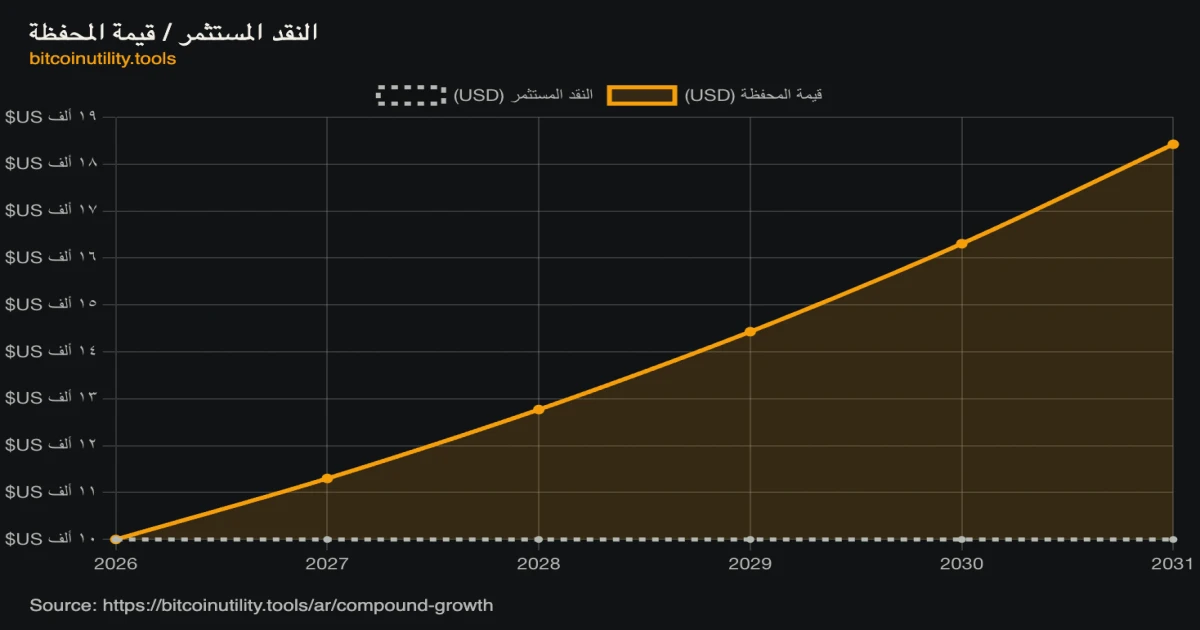 Figure 1: Illustrative $10,000 investment compounded annually at 13%, from 2026 through 2031. This is a mathematical projection generated with the Bitcoin Utility Tools Compound Growth Calculator, not a forecast of STRC, SATA, ASST, MSTR, bitcoin, or any other investment. It assumes the stated rate remains constant, dividends are reinvested, and there are no taxes, fees, dividend cuts, price changes, or missed payments.
What is ASST, and how does SATA differ from STRC?
ASST is Strive’s common stock, listed on Nasdaq. Strive markets itself as “the Daily Dividend Company,” built around a bitcoin treasury strategy similar to Strategy’s.[7]
SATA is Strive’s Variable Rate Series A Perpetual Preferred Stock, designed to pay cash dividends every business day rather than monthly. Strive raised SATA’s annualized dividend rate to 13% and has said its balance sheet could support the resulting dividend obligations for close to two decades under current assumptions.[8] Strive has used SATA proceeds specifically to fund additional bitcoin purchases.[9]
Strive’s own disclosures are explicit about SATA’s risk profile: SATA “is not collateralized by Strive’s bitcoin holdings and only has a preferred claim on the residual assets of the Company.” There is no guarantee of returns, liquidity, or future performance, and SATA is not FDIC insured or otherwise protected like a bank deposit or money-market fund.[10] The same structural caveat applies to STRC and Strategy’s other preferreds — the “collateral” language matters because it tells you what you’re actually a claim on if the company runs into trouble.
In January 2026, Strive acquired Semler Scientific (SMLR) — a healthcare technology company that had separately adopted a bitcoin treasury strategy — in an all-stock deal. The combined company’s holdings rose to roughly 12,798 BTC, making it the 11th-largest corporate bitcoin holder, ahead of Tesla.[11]
What is mNAV, and why does it matter?
mNAV (market-to-NAV) compares a treasury company’s market capitalization to the current market value of the bitcoin it holds. An mNAV above 1 means the market is paying a premium for the stock relative to its bitcoin backing; below 1 means a discount.
This isn’t abstract. In late November 2025, Forbes reported that Strategy’s market capitalization had fallen to about $49 billion — below the roughly $56 billion in bitcoin it held at the time.[12] A sub-1 mNAV removes one of the key mechanisms treasury companies rely on: issuing new shares at a premium to buy more bitcoin per share for existing holders. When the premium disappears, that flywheel stops, and additional share issuance can dilute existing holders instead of benefiting them.
Has STRC ever actually dropped below its $100 par?
Yes. STRC’s monthly dividend adjustment is designed to encourage trading near $100, but that par value was never a guaranteed floor — nothing in the security’s structure requires it to hold. In June 2026, as bitcoin fell toward the low $60,000s (well below Strategy’s own average purchase cost), STRC broke sharply lower, hitting a record low of roughly $75 in late June — a 25% discount to par.[14] MSTR common stock fell in parallel to a 52-week low near $81.81.[14]
The drop triggered real panic: retail investors held an estimated 83% of STRC, JPMorgan warned of “avoidable” two-way risk to bitcoin markets, and a law firm opened a securities investigation covering all five of Strategy’s listed securities.[14] Because STRC traded below par, Strategy’s at-the-market program for issuing new STRC shares was effectively paused — a preferred stock can’t be sold at a discount without diluting existing holders further, which temporarily closed off one of the company’s main bitcoin-buying channels.[15]
Strategy responded on June 29, 2026 with what it called its Digital Credit Capital Framework: raising STRC’s dividend rate from 11.5% to 12%, and authorizing bitcoin sales of up to $1.25 billion to fund reserves alongside up to $1 billion each in preferred and common stock buybacks. The same framework boosted Strategy’s USD Reserve — the cash buffer set aside specifically to cover preferred dividends — to $2.55 billion, equal to about 17.4 months of coverage; combined with the new BTC monetization capacity, total coverage rose to roughly $3.80 billion, or 25.9 months.[14][17] Strategy kept adding to that reserve through the summer, reporting $3.75 billion (about 25 months of coverage) by late July.[18]
STRC recovered from its lows toward $87 by early July, helped by the dividend increase, the larger reserve, and a partial bitcoin price recovery, though CoinDesk reported the stock was still lagging its $100 par as of September 2026 even after roughly $635 million in buybacks.[16]
The takeaway: STRC’s par-tracking mechanism worked for most of its first year, but it is a target the dividend adjustment aims for, not a contractual redemption price. A severe, sustained bitcoin drawdown can push it meaningfully below par, and getting back to par depends on bitcoin’s price recovering, the issuer building a bigger cash buffer, and deliberate buybacks — it isn’t automatic.
Where does the cash for STRC’s dividend actually come from?
A recurring mechanism: Strategy routinely sells new MSTR common shares through its at-the-market (“ATM”) program and uses the proceeds to fund STRC’s cash dividends, repurchase STRC shares, and top up the USD Reserve — not just bitcoin purchases. For example, during July 20–26, 2026, Strategy sold 5,429,160 MSTR shares via its ATM for $544.5 million in net proceeds, then used part of that to repurchase $25 million of STRC preferred shares and grow its cash reserve.[18][19] In early August 2026, Strategy also sold 1,638 BTC — a small fraction of its holdings — specifically to help fund STRC dividends and buybacks, alongside further MSTR ATM sales.[20]
In other words, MSTR common shareholders can be diluted specifically to keep cash flowing to STRC and other preferred holders during a bitcoin bear market, rather than the other way around — common equity effectively subsidizes the preferred stack’s dividend obligations when bitcoin’s price or Strategy’s operating cash flow can’t cover them alone.
What are the main risks of Bitcoin treasury company stocks?
- NAV/mNAV risk. Common stock can trade at a persistent premium or discount to the underlying bitcoin value, independent of bitcoin’s own price movements — see the MSTR example above.
- Dilution. Treasury companies routinely issue new common shares, convertible debt, or preferred stock to fund bitcoin purchases. That can increase bitcoin-per-share for existing holders when done at a premium — or dilute them when it isn’t.
- Dividend suspension or deferral. Preferred dividends like STRC’s and SATA’s are variable, adjusted periodically, and — per Strive’s own disclosure — “subject to monthly declaration by the Board of Directors and is not guaranteed.”[10] A cash-flow squeeze or a prolonged bitcoin bear market could see these rates cut or dividends suspended.
- No guaranteed par. STRC’s ~$75 low in June 2026 shows that the $100 par value these preferreds target is not a floor — see the section above for what happened and how Strategy responded.
- Common equity funds preferred obligations. Strategy has repeatedly sold new MSTR common shares via its ATM program to fund STRC’s cash dividends and buybacks — see the section above. That protects preferred holders’ cash flow at common shareholders’ expense.
- Leverage and debt serviceability. Long-duration corporate bonds avoid the forced-liquidation risk of margin loans, per Lyn Alden’s analysis, but a multi-year bitcoin bear market could still strain a company’s ability to service preferred dividends or refinance debt.[2]
- Liquidity and redemption differences. Common stock can be sold on an exchange at any time (subject to market liquidity). Perpetual preferred shares like STRC and SATA have no maturity date and are callable at the issuer’s discretion — investors depend on secondary-market liquidity to exit, not a fixed redemption date.
- No bitcoin collateral. As Strive discloses for SATA, and as applies structurally to Strategy’s preferreds too, these are unsecured claims on the company’s residual assets — not a direct claim on the underlying bitcoin.
Other bitcoin treasury approaches worth knowing
The model has spread beyond Strategy and Strive. Metaplanet (Tokyo: 3350), which pivoted from a hotel business to a bitcoin treasury strategy in April 2024, held roughly 43,000 BTC by mid-2026 and tracks a “BTC Yield” metric to measure bitcoin accretion per share — making it the third-largest corporate bitcoin holder globally behind Strategy and Twenty One Capital.[13] Semler Scientific (SMLR), a medical device company, ran its own bitcoin treasury strategy before being acquired by Strive in 2026.[11] Both illustrate that the same NAV, dilution, and leverage risks apply regardless of jurisdiction or industry — evaluate each on its own balance sheet, not just its bitcoin headline number.
Not investment advice
This article is educational research comparing publicly available structures, not a recommendation to buy or hold any specific security. MSTR, STRC, ASST, SATA, and every other product mentioned here carry equity, credit, and bitcoin-price risk, and preferred dividend rates can be cut or suspended. mNAV premiums can compress or turn negative without warning. Consult the issuers’ SEC filings and prospectuses and an independent financial adviser before investing.
Sources and limits
- Strategy’s bitcoin holdings: Wikipedia’s Strategy (MicroStrategy) entry, citing SEC filings and contemporary reporting, for the ~650,000 BTC / $59.7 billion figure as of November 17, 2025.
- Why investors use bitcoin treasury companies, and corporate leverage vs. margin loans: Lyn Alden, “The Rise of Bitcoin Stocks and Bonds” (July 2025).
- STRC (“Stretch”) structure and monthly rate adjustment: Strategy’s STRC information page.
- STRC dividend raised to 11.5%: CoinDesk, March 2026.
- STRC reserve coverage (~21.8 months): Seeking Alpha, “Strategy’s Stretch Preferreds Offer An 11.5% Yield Paid Monthly”.
- Four Strategy preferred/credit instruments, $4B raised, Saylor’s framing: Bloomberg, “Strategy’s Saylor Touts Bitcoin-Backed Credit Products” (September 2025), via Wikipedia’s MicroStrategy entry.
- Strive/ASST positioning as “the Daily Dividend Company”: strive.com.
- SATA dividend raised to 13%, ~19.6-year balance-sheet coverage estimate: Yahoo Finance, “Strive Raises SATA Preferred Yield to 13%; Tops Hut 8 in Bitcoin Holdings”.
- SATA proceeds used to fund bitcoin purchases: Crypto Briefing, “Strive raises funds to acquire 191 Bitcoin through its SATA preferred stock”.
- SATA risk disclosures (no BTC collateral, no guarantees, not FDIC insured, dividend not guaranteed): strive.com disclosures section.
- Strive’s acquisition of Semler Scientific and combined bitcoin holdings: Strive investor relations announcement.
- Strategy’s mNAV falling below 1 in November 2025: Forbes, “Will Bitcoin’s Dive Threaten Michael Saylor’s Strategy?”.
- Metaplanet’s bitcoin holdings and “BTC Yield” metric: bitcointreasuries.net Metaplanet profile.
- STRC’s June 2026 drop to a ~$75 record low, MSTR’s 52-week low, retail concentration, JPMorgan’s warning, the securities probe, and the Digital Credit Capital Framework: Tech Times, “Strategy Bitcoin Preferred Stock: JPMorgan Warns Retail Holders Face Deepening Loss” (July 2026).
- STRC’s at-the-market issuance pausing below par: AInvest, “STRC’s Crash Below $100 Is Panic, Not a Structural Break” (June 2026).
- Strategy’s ~$635 million in STRC buybacks and the stock still lagging par as of September 2026: CoinDesk, “Strategy spends $635M buying back STRC as perpetual preferred stock lags $100 par” (September 2026).
- Digital Credit Capital Framework’s USD Reserve boost to $2.55B / 17.4 months, plus $3.80B / 25.9 months combined coverage: Crypto Times, “Michael Saylor’s Strategy Boosts Reserve to $2.55B and Raises STRC Dividend to 12.00%” (June 2026).
- USD Reserve increased to $3.75B (~25 months coverage) funded via MSTR ATM sales, and initiation of STRC repurchases: Strategy press release, “Strategy Initiates STRC Repurchases and Announces Ongoing Buyback Policy” (July 2026).
- MSTR ATM sale of $544.5M (July 20–26, 2026) partly used to repurchase $25M of STRC shares: Cointelegraph, “Strategy Raises $544.5M and Buys Back STRC Shares” (July 2026).
- Strategy’s sale of 1,638 BTC in early August 2026 to fund STRC dividends and buybacks: The Coin Republic, “Strategy Sells 1,638 Bitcoin to Fund STRC Stock and Dividends” (August 2026).
- Scope note: This article compares corporate equity and preferred-stock treasury vehicles only. On-chain Bitcoin L2 and bridge-based yield products (a different risk model entirely — smart contract and bridge risk rather than dilution and dividend risk) are covered in our Bitcoin L2 yield and custody article.
- All figures (BTC holdings, dividend rates, mNAV, market capitalization) change frequently. Verify current figures directly with each issuer’s investor relations page and latest SEC filings before making any decision.
- This article is educational research, not personal financial advice. Past performance does not guarantee future results.
أبحاث
مزيد من الأبحاث
الاقتصاد الرقمي
رأس المال الرقمي والأسهم والائتمان والذكاء: أطروحة Strategy للاقتصاد الرقمي
قراءة نقدية لتصنيفات Strategy للاقتصاد الرقمي، من Bitcoin والأسهم المؤسسية إلى الأوراق المالية الممتازة والذكاء الاصطناعي.
فن ومقتنيات بيتكوين
فن بيتكوين ومقتنياته: أين تجد الأعمال المادية
دليل للمتاجر التي تبيع الفن والحرف والمقتنيات المادية المستوحاة من بيتكوين، مع نصائح لتقييم المنتجات والمزادات.